
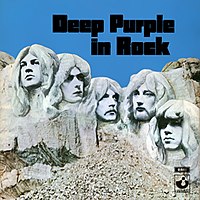
Shortly after the orchestral release, the band began a hectic touring and recording schedule that was to see little respite for the next three years. Their first studio album of this period, released in mid-1970, was Deep Purple in Rock (a name deliberately chosen to distance the rock album from the concerto) and contained the then-concert staples "Speed King", "Into The Fire", and "Child in Time". The band also issued the UK Top Ten single "Black Night". Blackmore's and Lord's guitar-keyboard interplay coupled with Ian Gillan's howling vocals and the rhythm section of Glover and Paice now started to take on a unique identity and become instantly recognisable to rock fans throughout Europe.
A second album, the more mellow and creatively progressive Fireball (a favourite of Gillan but not of the rest of the band), was issued in the summer of 1971. The title track "Fireball" was released as a single, as was "Strange Kind of Woman" - not from the album but recorded during the same sessions (although it was included on the US version of the album in lieu of the UK version's song Demon's Eye.)
Within weeks of Fireball's release, the band was already performing songs planned for the next album. One song (which later became "Highway Star") was performed at the first gig of the Fireball tour, having been written on the bus to a show in Portsmouth, in answer to a journalist's question: "How do you go about writing songs?" Three months later, in December 1971, the band traveled to Switzerland to record Machine Head. The album was due to be recorded at a casino in Montreux, using the Rolling Stones Mobile Studio, but a fire during a Frank Zappa and the Mothers of Invention gig burned down the casino. The album was actually recorded at the nearby empty Grand Hotel. This incident famously inspired the song "Smoke on the Water". Gillan believes that he witnessed a man fire a flare gun into the ceiling during the concert, prompting Zappa to comment: "Arthur Brown in person!"
Continuing from where both previous albums left off, Machine Head has since become one of the band's most famous albums, including tracks that became live classics such as "Highway Star", "Space Truckin'", "Lazy", and "Smoke on the Water." Deep Purple continued to tour and record at a rate that would be rare thirty years on: when Machine Head was recorded, the group had only been together three and a half years, yet it was their seventh LP. Meanwhile the band undertook four US tours in 1972 and the August tour of Japan that led to a double-vinyl live release, Made in Japan. Originally intended as a Japan-only record, its world-wide release saw the double become an instant hit. It remains one of rock music's most popular and highest selling live-concert recordings (although at the time it was perhaps seen as less important, as only Glover and Paice turned up to mix it).
The classic Purple Mk 2 line-up continued to work and released the album Who Do We Think We Are (1973), featuring the hit single "Woman from Tokyo", but internal tensions and exhaustion were more noticeable than ever. The bad feelings culminated in Ian Gillan quitting the band after their second tour of Japan in the summer of 1973, and Roger Glover being pushed out with him. Their replacements were an unknown singer from Saltburn in North East England, David Coverdale, and Midlands bassist/vocalist Glenn Hughes, formerly of Trapeze. According to the liner notes for the 30th anniversary edition of Burn, after first acquiring Glenn Hughes, they debated continuing as a four piece with Hughes as both bassist and vocalist.This new line-up continued into 1974 with the heavier blues-rock album Burn, another highly successful release and world tour. Hughes and Coverdale added both vocal harmonies and a more funky element to the band's music, a sound that was even more apparent on the late 1974 release Stormbringer. Besides the title track, the album had a number of songs that received much radio play, such as "Lady Double Dealer", "The Gypsy", and "Soldier Of Fortune". Yet Blackmore voiced unhappiness with the album, and as a result left the band in the spring of 1975 to form his own band with Ronnie James Dio of Elf, called Ritchie Blackmore's Rainbow, then shortened after one album to Rainbow.
With Blackmore's departure, Deep Purple was left to fill one of the biggest bandmember vacancies in rock music. In spite of this, the rest of the band refused to stop, and to the surprise of many long-time fans, actually announced a replacement for the "irreplaceable" Man in Black; American Tommy Bolin.
There are at least two versions about the recruitment of Bolin: according to the liner notes in the Deep Purple 4-CD boxed set it was Coverdale who had suggested auditioning Bolin. "He walked in, thin as a rake, his hair coloured green, yellow, and blue with feathers in it. Slinking along beside him was this stunning Hawaiian girl in a crochet dress with nothing on underneath. He plugged into four Marshall 100-watt stacks and . . .the job was his." But in an interview originally published by Melody Maker in June 1975 and available at the Deep Purple Appreciation Society's (DPAS) website, Bolin himself claimed that he came to the audition following a recommendation from Ritchie Blackmore [1]. Bolin had been a member of many now-forgotten mid-60s bands - Denny & The Triumphs, American Standard, and Zephyr, which released three albums from '69-72. Before Purple, Bolin's best-known recordings were made as a session musician on Billy Cobham's 1973 jazz fusion album, Spectrum, and on The James Gang's Bang (1973) and Miami (1974). He had also jammed with such luminaries as Dr. John, Albert King, and Alphonse Mouzon and was busy working on his first solo album, Teaser, when he accepted the invitation to join Deep Purple.
The resulting album, Come Taste the Band, was released in October 1975. Despite mixed reviews, the collection revitalised the band once again, bringing a new, extreme funk edge to their hard rock sound. Bolin's influence was crucial, and with encouragement from Glenn Hughes and David Coverdale, the guitarist developed much of the material. Later, Bolin's personal problems with drugs began to manifest themselves, and after cancelled shows and below-par concert performances, the band was in danger.


No comments:
Post a Comment